
Offshore sportsbooks accept US players who state-regulated books can’t.
If you’re in Texas, California, or Florida – or you just want bigger bonuses, crypto payouts, and fewer account restrictions – international betting sites are
We studied lots of offshore sportsbooks for their payout speed, bonus terms, US state access, odds quality, and banking variety. The top three offshore sportsbooks below represent the strongest picks across those criteria.

BetNow delivers straightforward offshore betting with one of the lowest rollover options available.
BetNow has been operating since 2015, licensed under the Government of Anjouan, and built specifically for the US market. The standout for new bettors is the WELCOME30 crypto-only bonus code: a 30% cash bonus with a 5x rollover requirement. That’s the most forgiving rollover in this field. If you deposit $200 and take the WELCOME30 offer, you need to wager $1,500 before withdrawal – manageable if you’re betting regularly on NFL or NBA.
Crypto deposits are fee-free across Bitcoin, Ethereum, Litecoin, Tether, Bitcoin Cash, USD Coin, and Binance. Payouts process in 24-48 hours. The weekly 2% sportsbook rebate on net losses runs automatically – no opt-in required, which is a detail that adds real value over a season.
Pros:
Cons:
Verdict: BetNow is the cleanest entry point in offshore sports betting for US players who want low rollover requirements and reliable crypto payouts without the noise.
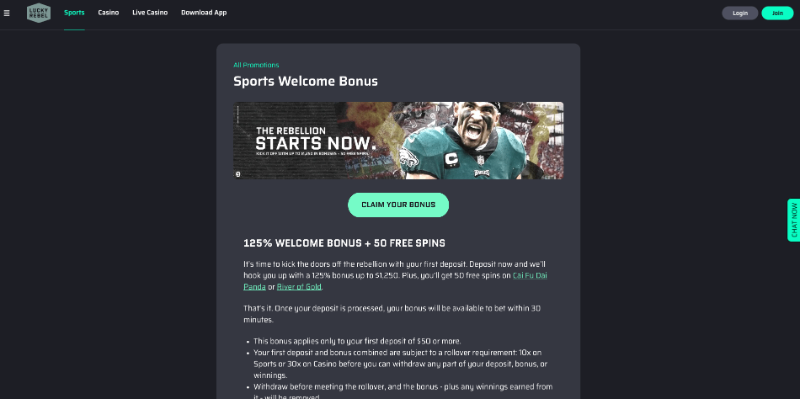
LuckyRebel processes crypto withdrawals in under an hour – faster than any other book on this list.
Launched in 2025 and licensed by the Mwali International Services Authority, LuckyRebel is the newest entry here and already punching above its weight in two areas: live betting depth and payout speed. The platform runs 80+ in-play markets simultaneously with real-time stats, making it the strongest option if you’re betting games in progress. The 125% welcome bonus up to $1,250 comes with a 10x rollover on deposit plus bonus – standard for the offshore market.
Sports coverage spans 30+ sports, including niche markets like pickleball. The $10 crypto minimum deposit is the lowest in this comparison. Worth knowing: withdrawals are crypto-only – no fiat options, which is fine for most crypto-first bettors but rules LuckyRebel out if you need a check or bank wire.
Pros:
Cons:
Verdict: LuckyRebel is the top pick for crypto-first bettors who want instant payouts and serious live betting depth across a broad sports menu.
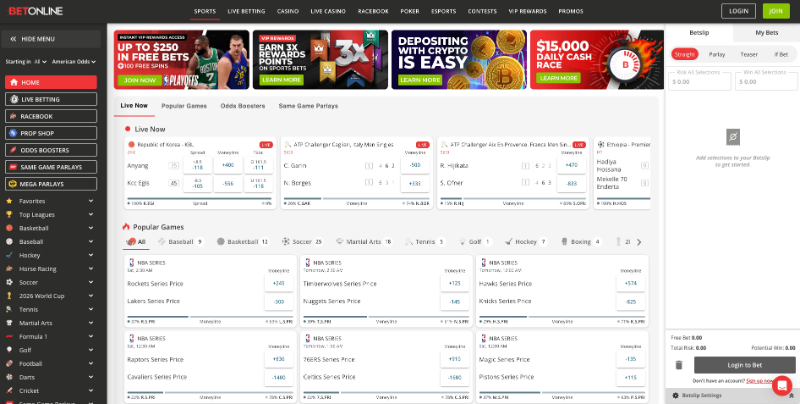
BetOnline has operated since 2001, carries a Panama Gaming Commission license, and offers deep betting markets on this list.
The appeal for experienced bettors is specific: early lines, 16+ cryptocurrencies, a props builder for custom markets, and an all-in-one account covering sportsbook, casino, and poker. BetOnline posts lines earlier than most offshore books, which matters if you’re hunting for value before the market sharpens. The 50% welcome bonus up to $250 is structured as a free bet – straightforward without the rollover complexity of matched deposit offers.
Crypto withdrawals process within 24 hours, with the fastest transactions completing in about an hour during business hours. Note that BetOnline restricts access to New Jersey – if you’re betting from there, the other books on this list are your route.
Pros:
Cons:
Verdict: BetOnline is the strongest offshore sportsbook for experienced US bettors who prioritize market depth, early odds, and a proven 25-year track record.
An offshore sportsbook is a betting operator licensed outside the United States – typically in jurisdictions like Curacao, Panama, Antigua and Barbuda, or the Comoros Union – that accepts US players without holding a state gaming license.
The “offshore” designation describes where the operator is licensed, not where you’re betting from. You’re sitting in the US placing bets on an American football game – the sportsbook’s servers and regulatory status are elsewhere. International sportsbooks like BetOnline (licensed in Panama since 2001) and BetUS (established 1994, now Mwali-licensed) have served US bettors through multiple regulatory eras precisely because the licensing jurisdiction allows it.
Here’s where offshore sports betting sites differ from state-regulated domestic books:
Why do US bettors use offshore sports betting sites even in states with legal domestic options? Three reasons come up consistently: higher limits for winning bettors, broader betting menus including props and international leagues, and bigger bonuses. The consumer-protection trade-off is real – no FDIC-style guarantees exist here. But the top offshore sportsbooks have multi-decade payout histories, and that track record is the closest thing to structural protection available.
No US bettor has ever been prosecuted solely for placing bets at an offshore sportsbook. That’s the direct answer.
Here’s the federal framework behind it. The Wire Act of 1961 targets operators transmitting bets across state or national lines – not the individual placing the wager. UIGEA (Unlawful Internet Gambling Enforcement Act, 2006) targets financial institutions and operators who process gambling transactions, not bettors themselves. PASPA – the Professional and Amateur Sports Protection Act – was repealed by the Supreme Court in 2018, which gave states the authority to legalize sports betting but did not criminalize individual offshore betting at any point before or after repeal.
The enforcement target in US gambling law is consistently the operator, not the customer. Operating an offshore gambling site targeting US players is the legal risk. Using one is not.
Key points for US bettors:
State-level variation exists. Most states have no law specifically targeting individual online bettors. A handful of states – including Utah and Hawaii – prohibit all gambling in their constitutions, though even there, prosecutions of individual bettors for offshore use are not on record. Offshore gambling sites operate in a legal gray area, and that status can change. Laws evolve, and it’s worth understanding the framework.
The practical distinction that matters: using an offshore sportsbook as a bettor carries a different legal risk profile than operating one. The DOJ and state attorneys general have pursued operators – never the bettors.
The best offshore betting sites serve different betting styles. One book’s strength is another’s weakness. Here’s where each one leads.
LuckyRebel is the top call for in-play action, with 80+ simultaneous live markets and instant platform updates.
Live betting at LuckyRebel runs on real-time stats – no live streaming, but the market depth makes up for it when you’re covering multiple games. BetUS brings a different scale to the live table: 200+ live games daily across the week, with 300-400 props per live game.
Is a deep live prop menu worth more to you than instant settlement? BetUS for volume, LuckyRebel for speed and market breadth – choose based on how you actually bet.
BetUS leads on prop volume with 300-400 props per live game and a dedicated prop builder.
The best offshore sports betting sites for props go beyond standard game-day markets. BetUS covers same-game parlays, pleasers, and a prop builder that lets you combine player props across a single game – a rare feature. BetOnline’s props builder operates similarly, with custom derivative props and alternate spreads/totals for sharper market access.
LuckyRebel processes crypto withdrawals in under an hour – no fiat options, no delays, no caps.
Best offshore betting goes further for crypto users than just accepting Bitcoin. LuckyRebel’s $10 crypto minimum deposit is the lowest on this list, and the no-maximum withdrawal cap means high-volume bettors aren’t waiting on multiple transactions. BetOnline supports 16+ cryptocurrencies, including less common options, giving you flexibility if you hold assets beyond BTC.
BetOnline is the strongest choice for sharp bettors – early lines, high limits on major markets, and documented tolerance for winning accounts.
Best offshore sportsbooks for high-volume bettors live and die on line quality and account longevity. BetOnline posts early lines specifically because it wants sharp action to help set the market – that’s the opposite of a book that limits winners. BetUS extends limits to $100,000 on NFL sides and offers an extensive futures menu where value accumulates. For bettors staking serious volume, account restriction is the real concern – books that shade lines against sharp players are common. The offshore market generally tolerates winners better than domestic books.
Offshore bonuses look larger than domestic offers because they are, but the rollover requirement determines whether that size translates to real value.
A domestic book might offer a $50 bonus with no rollover. An offshore sportsbook offers 125% up to $1,250 with a 10x rollover. Which is better? That depends entirely on how much you bet.
Here’s the mechanic with a concrete example: you deposit $500, claim a 100% bonus, and receive $500 in bonus funds. With a 10x rollover, that’s $10,000 in total wagers required before you can withdraw. At $100 per bet average, you need 100 bets before withdrawal is unlocked. At $50 per bet, you need 200. The offshore sportsbook’s standard rollover range runs 8-15x. Domestic books typically require 1x or none.
BetNow illustrates how rollover tiers work within a single operator. The WELCOME30 code gives a 30% bonus at 5x rollover – the minimum total wagering is low. The CASH100 code offers 100% at 25x – the bonus is larger but withdrawal is locked much longer. Same book, different strategic choices depending on your betting volume.
BetUS’s 125% up to $3,125 (JOIN125) carries a 14x sports rollover. Deposit $500, receive $625 in bonus, and you need to wager $15,750 before withdrawal. That’s real money in the betting cycle. The 225% option (JOIN225) pushes the rollover higher. Best offshore sports betting value isn’t always the biggest headline number.
Reduced juice is the alternative worth knowing. Some offshore books offer lines at -105 rather than the standard -110. Over hundreds of bets, that half-point swing in vigorish is worth more than a one-time welcome bonus. Best online sportsbook offshore value often lives in the ongoing line quality, not the sign-up offer.
Bonus Red Flags to Avoid:
Crypto is the fastest and most reliable deposit and withdrawal method for US players at offshore betting sites. Full stop.
The reason card declines happen has nothing to do with the sportsbook – it’s UIGEA compliance. UIGEA requires US financial institutions to block transactions to and from gambling operators. The sportsbook accepts the transaction; your bank or card issuer is the one declining it. This is why credit card acceptance rates at offshore gambling sites run around 60-70%, the decline is issuer-level, not site-level. Debit cards clear at a higher rate than credit cards. American Express is rarely accepted.
Crypto covers Bitcoin (BTC), Ethereum (ETH), Litecoin (LTC), Tether (USDT), and Bitcoin Cash (BCH) at most offshore sportsbooks. Most books charge no fees on crypto transactions in either direction. LuckyRebel processes withdrawals in under an hour. BetNow runs 24-48 hours. International betting sites that operate primarily on crypto infrastructure have no reason to impose transfer fees, and most don’t.
A Bitcoin deposit takes three steps: create a crypto wallet if you don’t have one, purchase BTC on an exchange like Coinbase or Kraken, and send it to the deposit address your sportsbook provides. The deposit clears in minutes after one blockchain confirmation.
Apple Pay, Google Pay, and PayPal are not available at offshore sportsbooks accepting US players. This surprises people who use those methods for everything else, but the UIGEA compliance requirements make these gateways non-functional for offshore gambling transactions.
Bank wire works for large withdrawals at most books and clears in 3-7 business days with fees typically in the $35-$50 range. It’s the right method if you’re pulling out five figures and you’re not set up for crypto. Check by mail takes longer but carries low UIGEA friction – useful if crypto and wire aren’t options.
Accepting a bonus ties your deposit to a rollover requirement, which delays any withdrawal regardless of the book’s standard payout speed.
The offshore online gambling mechanic works like this: you deposit $500, claim a $500 matched bonus. You now have $1,000 in your account. With a 10x rollover, you must place $10,000 in total wagers before you can withdraw anything. At $100 per bet, that’s 100 bets – a full betting cycle for most recreational bettors.
That $10,000 target isn’t a barrier to winning – it’s a barrier to withdrawing. You can win or lose throughout. But until the rollover completes, your withdrawal is locked.
Key points on rollover and withdrawals:
When should you decline the bonus? If you plan to withdraw within the first month, or if your typical betting volume is low, skipping the welcome bonus is often the smarter financial decision. The best offshore sportsbooks for US players that offer low rollover alternatives – BetNow’s WELCOME30 at 5x, MyBookie’s sports bonus at 5x – are worth comparing against books with double-digit rollover requirements.
Sportsbooks offshore that offer cashback and rebate structures sidestep the rollover problem entirely. BetNow’s 2% weekly sportsbook rebate pays out on net losses with no rollover attached. For bettors who value consistent returns over a large upfront bonus, that structure delivers more predictable value. The best offshore sportsbook for you is often the one whose bonus structure matches how you actually bet – not the one with the largest headline number.
Offshore sportsbooks offer genuine advantages over domestic regulated books, alongside real trade-offs worth understanding before you deposit.
The two most important facts in that list: offshore betting is available in all 50 states, and there’s no state regulator behind you if a payout dispute arises. Those two facts sit at the center of every decision you’re making here.
For most bettors in TX, CA, and FL – where domestic legal sports betting remains unavailable or limited – the offshore market isn’t an alternative. It’s the only option. The offshore sports betting sites that have operated for 10-30 years have payout histories that function as de facto reliability evidence, even without regulatory guarantees.
The card decline issue is real but solvable. Set up a crypto wallet before you deposit, and the banking friction disappears entirely.
Opening an account at an offshore sportsbook takes about 10 minutes. Here’s exactly what happens.
Most offshore sportsbooks accept players from all 50 US states. That’s the broad rule – and it’s the primary reason millions of bettors use them.
State access: what you need to know
Which states make offshore sports betting most relevant? The list is long but the high-demand cases are clear:
Some offshore books self-restrict to manage regulatory exposure. BetOnline is documented as restricted in New Jersey – a state with a strong domestic regulated market and an aggressive gaming commission. MyBookie restricts NV, NJ, NY, and MI for similar reasons. BUSR has faced a cease-and-desist in Michigan. These restrictions are operator decisions, not federal law – other books in this group accept those states.
The VPN question comes up regularly. The logic seems sound – connect through a different state, bypass the restriction. The problem is KYC. When you submit ID documents at withdrawal, your address and state will conflict with the IP address used to register. That creates account verification failure risk and, at worst, voided withdrawals. It’s not a recommended approach.
No individual US bettor in a non-restricted state has faced prosecution for using offshore sports betting sites. The enforcement target is the operator. That distinction is documented in every major federal enforcement action on record.
US bettors owe federal income tax on all gambling winnings regardless of where the offshore sportsbook is located.
The IRS does not exempt offshore gambling income. Winnings are ordinary income and reportable on your federal return under IRS Topic No. 419. The W-2G threshold – $600 in winnings or 300x the wager – applies to operator-issued forms, which offshore books do not provide. But that threshold governs paperwork from the operator. Your obligation to report the income exists independent of any form you receive.
How does the IRS detect offshore gambling income? Three primary channels: large cryptocurrency conversions to USD, significant wire transfers from offshore accounts, and unusual bank deposit patterns. FBAR (FinCEN Form 114) rules apply to foreign financial accounts exceeding $10,000 in aggregate value during the calendar year. If your sportsbook account balance or your crypto holdings tied to gambling activity cross that threshold, FBAR filing is required.
Recordkeeping is your responsibility at offshore gambling sites. No offshore sportsbook provides year-end tax documents equivalent to a W-2G or 1099. Maintain your own session log: date, sport, wager amount, winnings or losses. Keep deposit and withdrawal receipts from your crypto wallet or bank. The IRS allows gambling losses to offset winnings, but only if you can document them – and only if you itemize deductions.
The practical steps: track every bet, keep every withdrawal record, and convert your crypto winnings records at the fair market value on the date of conversion. Sportsbooks offshore do not do this for you.
Important: This section provides general information only and does not constitute tax advice. Gambling tax rules are complex and fact-specific. If you have significant offshore gambling activity, consult a tax professional with experience in gambling income. Reference IRS Publication 529 and IRS Topic No. 419 for official guidance.
Reviews are based on real account testing – deposits, wagers, and withdrawal requests followed through to completion – not operator-supplied information.
Every offshore sportsbook in this list has been evaluated through actual account creation and funded testing. At minimum, one crypto deposit and one withdrawal request were completed per operator. The list of offshore sportsbooks here reflects only books that passed payout testing. Any book with unresolved withdrawal delays during testing is excluded.
Primary evaluation criteria, in order of weight:
Criteria explicitly excluded from evaluation:
Best offshore sports betting evaluations are only as current as the last test. Material changes – ownership transfers, licensing updates, new withdrawal reports, or new deposit methods – trigger a review update. Bonus terms change frequently; terms verified at time of review may differ from current offers. Top 5 offshore sportsbooks rankings reflect conditions as of 2026 and are updated when verified changes occur.
Offshore sportsbooks are not subject to the same mandatory responsible gambling infrastructure as state-licensed operators. That makes player-initiated controls more important, not less.
Most reputable offshore books offer deposit limits, loss limits, session time limits, cooling-off periods, and self-exclusion. These tools exist – use them before you need them. Set a deposit limit on day one.
Warning signs that betting may be causing harm:
Gambling is entertainment with a defined budget. It is not a revenue strategy.
Support resources:
Set your limits before depositing. Not after losing.